
12 Dark Gray Limewash Bedroom Wall Ideas for a Moody, Textured Retreat
A dark bedroom wall can feel flat and heavy when it is painted in ordinary matte paint. The same color in limewash behaves differently. The surface looks cloudy, with lighter and darker patches that shift as daylight changes, so a charcoal wall reads as soft instead of blocky.
This guide collects 12 dark grey limewash bedroom wall ideas, shows which colors and materials sit well next to them, and explains how to apply the finish without the usual mistakes. If you are weighing a single accent wall against a full wrap, the ideas below cover both.
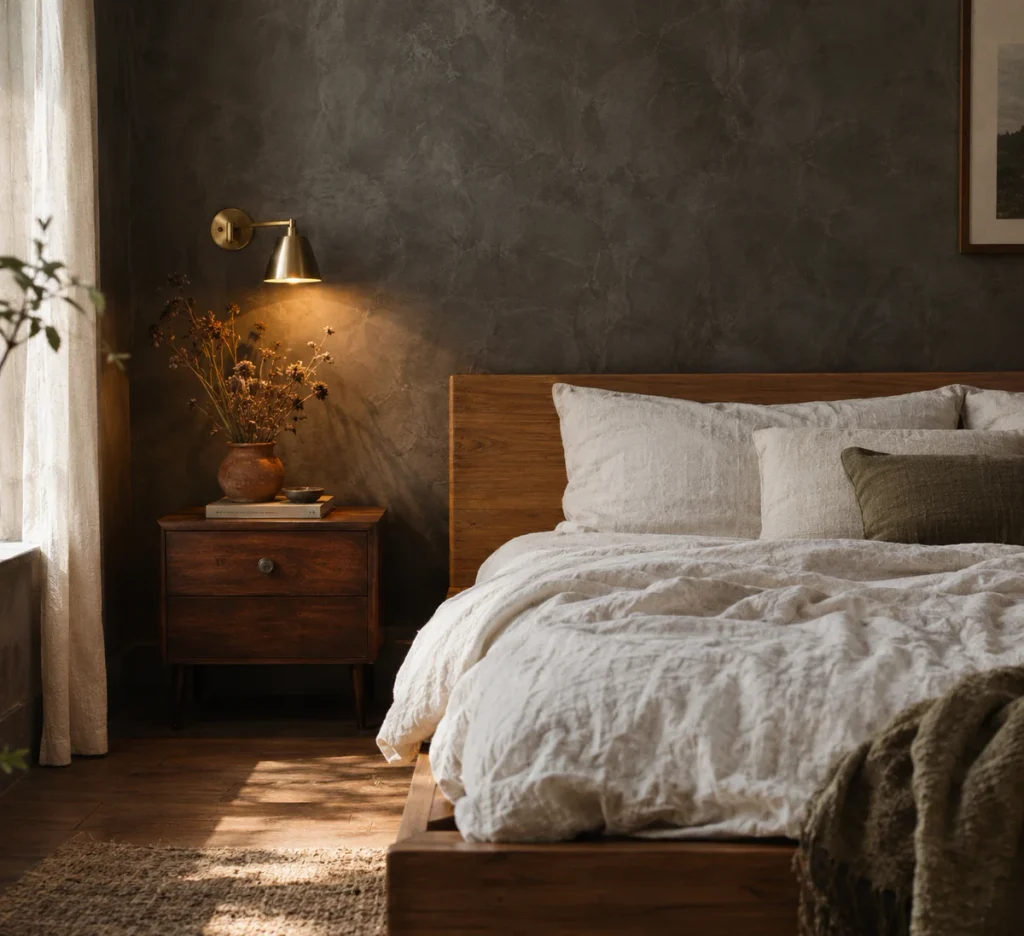
[Image: dark gray limewash bedroom wall behind a white upholstered bed | alt text: dark gray limewash bedroom wall with white bedding and warm bedside lamps]
What dark gray limewash actually is
Limewash is a traditional wall finish made from slaked lime, which is calcium hydroxide mixed with water, plus pigment for color. Wikipedia’s entry on whitewash and limewash explains that it cures by reacting with carbon dioxide in the air and turning into calcium carbonate, the same mineral found in chalk and limestone.
Two points from that description shape every decision in a bedroom:
- Limewash is absorbed into the surface instead of forming a film on top, which is why it looks mottled and chalky rather than uniform.
- It starts out very thin and translucent, so beginners tend to load the brush too heavily. Thin coats build the depth that makes dark gray look rich.
Many modern products are pre-mixed, mineral-based paints that are sold as limewash and can be used on drywall with the right primer. Always follow the manufacturer’s instructions for the specific can you buy, because formulas differ.
12 dark gray limewash bedroom wall ideas
1. A charcoal limewash wall behind the bed
The wall behind the headboard is where most people start, and it is the safest first project. The bed sits in front of the darkest area, so you see the texture most clearly at the moment you walk in and when you are lying down.
Keep the other three walls a warm off-white. That contrast keeps the room from feeling closed in, and any uneven brushwork on the dark wall looks intentional instead of accidental.
[Image: alt text: charcoal limewash accent wall behind a bed with off-white side walls]
2. Color-drenched walls and ceiling
If your room has low light and you want it to feel like a cocoon, carry the same dark gray onto the ceiling. With no sharp line between wall and ceiling, the room reads as one soft volume.
This works best when you choose a warm-leaning gray with a brown or green undertone. A cool blue-gray used everywhere can feel like a basement.
3. Pale linen bedding against deep gray
White, cream and oatmeal linen look best against a dark limewashed wall because the fabric’s own wrinkles echo the cloudy wall. Avoid glossy sateen sheets here. The sheen competes with the matte, chalky finish.
A single wool throw in rust or camel adds warmth without breaking the quiet palette.
4. Warm wood furniture for balance
Oak, ash and walnut stop dark gray from turning cold. Pick one wood tone and repeat it on the nightstands, a bench or the bed frame, rather than mixing three finishes.
If your furniture is already dark, add one lighter wood item, such as a stool or a small shelf, so the room has a point of relief.
5. Black metal accents in small doses
A matte black wall sconce, a slim iron frame or a drawer pull picks up the depth of the wall without adding bulk. Stay with two or three black pieces. More than that and the wall stops being the focus.
6. A Japandi bedroom with a low platform bed
Japandi bedrooms combine Japanese restraint with Scandinavian warmth. A low bed, a paper pendant or floor lantern and a single ceramic vase suit a dark gray limewashed wall because the texture does the decorating.
Leave plenty of empty wall. Limewash needs space to be seen.
7. A wabi-sabi look with rough ceramics and dried branches
Wabi-sabi values worn, handmade and imperfect things, and uneven limewash fits that idea naturally. Place a handmade bowl, a stone, or a few dried branches in a tall vase on a bedside table.
If you like this handmade, weathered mood, the same thinking shows up outdoors in our half barrel planter ideas for a charming garden, where worn wood and natural material do the work.
8. Two-tone limewash with a lighter upper wall
Paint the lower two thirds of the wall in dark gray limewash and the upper third, plus the ceiling, in a lighter gray or warm white. The darker band grounds the bed while the lighter top keeps the ceiling feeling high.
The join does not need to be razor sharp. A softly feathered edge suits the finish.
9. One dark wall in a small bedroom
In a small bedroom, one dark wall is usually enough. Dark colors visually pull a wall closer, so choose the wall that is farthest from the door and keep the others light.
The same logic helps in other tight rooms. If you are working with a compact space elsewhere in the house, our guide on how to decorate a small living room in the USA walks through the same balance of dark, light and furniture scale.
10. Olive or forest green next to gray
A green velvet bench or an upholstered olive headboard looks calm against charcoal. The two colors are both muted and earthy, so they sit together without clashing.
11. A limewashed fireplace wall or alcove
If your bedroom has a chimney breast, a niche or a built-in alcove, limewash only that feature. It becomes a quiet focal point and gives you a smaller area to practice on before committing to a whole wall.
12. Layered textiles on the floor and window
A wool or jute rug in oat or sand, plus curtains in unbleached linen, soften the hard edge of dark walls. Hang curtains close to the ceiling and let them fall to the floor. That adds height and balances the weight of the wall.
If you are furnishing a room on a budget, our list of affordable living room decor ideas includes inexpensive textiles and lighting swaps that work just as well in a bedroom.
Colors and materials that pair well with dark gray limewash
| Element | Good match | Why it works |
|---|---|---|
| Bedding | Cream, oat, soft white linen | Contrast without a harsh edge |
| Wood | Oak, ash, walnut | Adds warmth to cool gray |
| Metal | Matte black, aged brass | Echoes depth, avoids shine |
| Accent color | Olive, rust, dusty blue | Muted shades keep the mood calm |
| Rug | Wool or jute in sand or oatmeal | Lightens the floor plane |
| Light bulbs | Warm white, about 2700K | Keeps gray from looking cold at night |
How to apply dark limewash to a bedroom wall
Product instructions come first. As a general process:
- Check the surface. Limewash bonds best to porous, plaster-like surfaces. On painted drywall, use the primer recommended by the product’s manufacturer.
- Test on a board or a hidden section. Limewash looks much darker when wet and lightens as it dries, so judge the color only after it has dried fully.
- Dampen the wall if the instructions call for it. Wikipedia’s whitewash entry notes that a wall that is too dry can leave the lime powdery on the surface, while a saturated wall can cause failure.
- Use a large masonry or limewash brush and work in X-shaped or crisscross strokes. Avoid a roller if you want the cloudy effect.
- Apply thin coats and let each dry before the next. Dark colors show brush marks more than pale ones, so keep a consistent stroke direction and work quickly in sections.
- Cut in along corners and trim last, and keep a wet edge so you do not leave obvious joins.
Safety notes
Lime is alkaline and can irritate skin and eyes. The CDC’s NIOSH Pocket Guide entry for calcium hydroxide lists irritation and burns to the eyes and skin among its symptoms and recommends preventing skin and eye contact. Wear goggles and gloves, protect floors and furniture, ventilate the room, and wash splashes off straight away. If you are mixing limewash from dry hydrated lime, wear a dust mask rated for fine powder as well.
For older homes with historic plaster, read about lime plaster on Wikipedia and consult a conservation-minded plasterer before applying anything modern.
Common mistakes to avoid
- Judging the color while it is wet. Wait for full dry time before deciding on another coat.
- Using thick coats. Thick limewash looks opaque and flat, which defeats the point.
- Choosing a gray that fights your lighting. North-facing rooms often pull gray toward blue, so test next to your bedding.
- Dark walls with cold bulbs. Swap in warm bulbs so the wall looks soft at night.
- Covering the whole room in dark gray without any light surface. Leave at least one pale element, such as bedding or a ceiling.
Frequently asked questions
Does dark gray limewash make a bedroom look smaller?
Dark colors tend to make walls feel closer, so very small rooms can feel snug. In a small bedroom, limit dark limewash to one wall, keep the ceiling light and use warm lighting.
Can you limewash drywall?
Yes, with the right preparation. Modern pre-mixed products are formulated for drywall when used with the primer the manufacturer specifies. Traditional lime-based mixes work best on porous plaster, brick and stone.
How many coats of limewash do you need?
Usually two to three thin coats. Dark colors often need more to build depth and even out patchiness, but always follow the product label.
Do you use a brush or a roller?
A brush gives you the cloudy, hand-finished look. A roller tends to flatten the effect.
Does limewash look darker when wet?
Yes. The color changes noticeably as it dries, so test a sample and wait before choosing your final shade.
How do you clean limewashed walls?
Avoid scrubbing. The finish is porous and can mark if rubbed hard. For small marks, many makers suggest dabbing gently or touching up with a thin coat of the original color.
Is limewash a good choice for a bedroom?
It suits a bedroom when you want a quiet, matte, textured wall. It will not suit people who prefer a perfectly uniform finish, because variation is part of the look.
Final thoughts
Dark grey limewash bedroom wall ideas succeed when the wall is allowed to be the star and everything else stays soft. Pick one dark surface, repeat one wood tone, keep the bedding pale, and use warm light. Test your color on a board before committing.